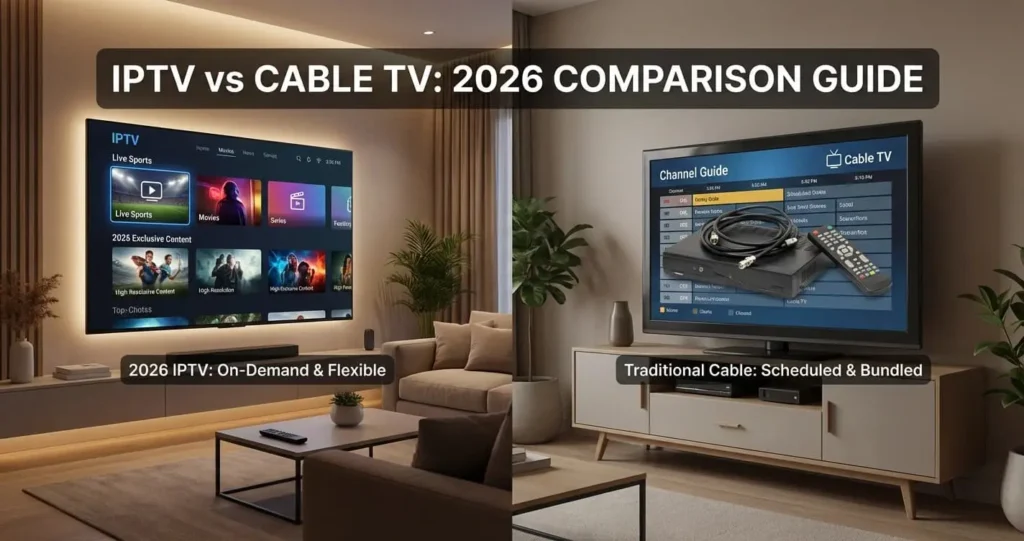
The struggle as to who is going to have control of your television screen has never been as intensely competitive as it is today. Conventional cable television has been the unchallenged king of home entertainment for decades. The new competitor today is strong: IPTV. You read the words surrounding you everywhere.
At a Glance: The Quick Answer

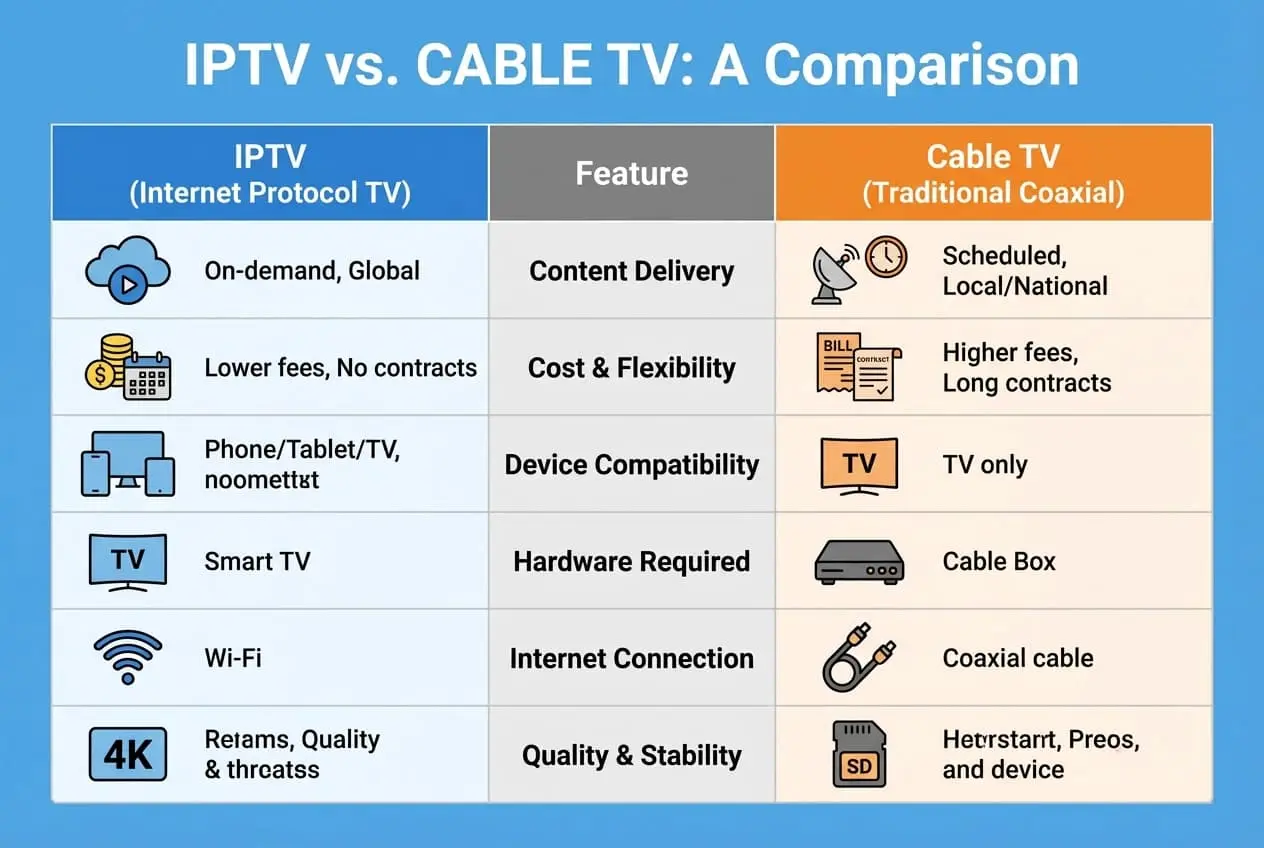
In a summary comparison of IPTV and cable TV, the following is the skim picture of their comparison. The main distinctions between the two stations, IPTV and cable TV, in a nutshell.
IPTV vs. Cable TV: Who is the winner?
| Feature | Internet Protocol Television (IPTV) | Cable TV (Traditional) |
| Technology | Gives you the contents of your internet. | Dissemination of the material by way of a physical coaxial cable system. |
| Content | A tremendous variety of thousands of worldwide/niche outlets. | A sieved selection of good local and popular national channels. |
| Cost Model | In fact, the flexible monthly/annual subscriptions are without opportunity costs. | Typically requires non-short-term contracts and packages. |
| Flexibility | Hi. Watch virtually on internet-enabled phones, tablets, PCs, and smart TVs. | Low. Mounted to a set-top box, which gets attached to a TV. |
| Key Feature | Video on demand (VOD) tables and liberation of gadgets on a massive scale. | Very high stability of signal and ease of operation. |
What is IPTV? Studying the Internet-Based Approach.
Internet Protocol Television may be referred to as IPTV. It is just a matter of bringing the television services to your living room through the means of live channels, movies, and shows over the internet via an already established internet connection.
When you select a channel on the IPTV service, you are asking a server, and the content is then sent back to you. It operates under the same principle as streaming platforms like Netflix or YouTube, except that it focuses on availing live broadcast channels as well as on-demand media. What is IPTV in Dubai, UAE?
What is cable TV? Understanding through the Traditional Broadcast Method.
Cable TV was the most popular service, which we have been accustomed to since our childhood. It works by relaying TV signals through a special network consisting of physical coaxial cable all the way through to your home.
Each channel of a cable company is sent simultaneously over this closed network, and a set-top box in your home is listening to a specific frequency, which is broadcast to air the channel of your choice. It is not dependent on the common internet as its primary content delivery platform, as IPTV is.
Defining the Technologies:
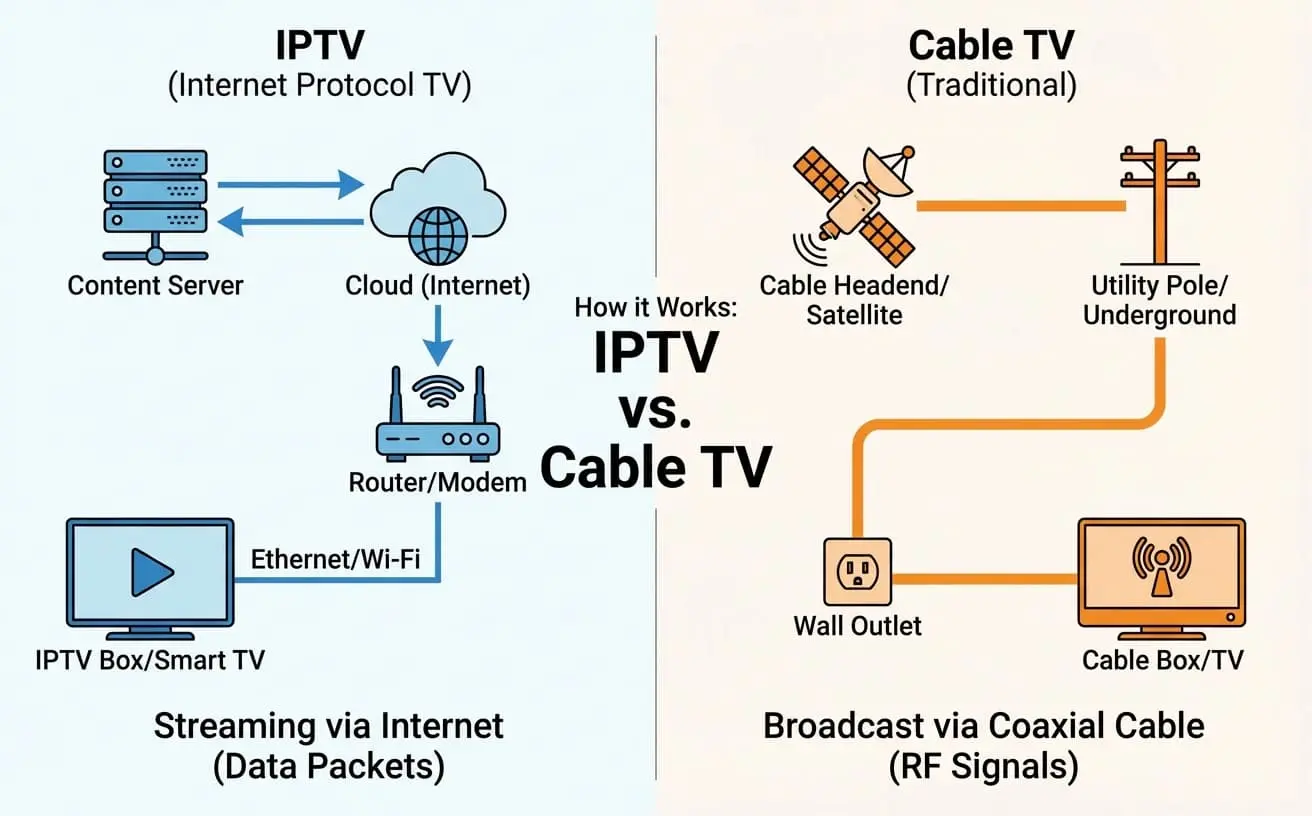
To make a fair comparison between the two technologies, we need to have a clue of the mechanics behind each of the technologies.
The Comparative Study: Head-to-Head Pug Fight.
We shall this time make a close-up and compare the two services in many aspects that most interest you as a consumer.
Content & Variety: Who Offers More Choice?

The IPTV Plus: Global and Niche Channels.
Here IPTV really excels. The reputation of the IPTV services is that they can provide an extremely impressive number of channels, in the range of thousands and even tens of thousands. This includes sporting, movie, and local content of high quality in dozens of different countries. A simple IPTV box or an IPTV application can bring you to the world of entertainment. [How to set up an IPTV box in Dubai?]
The amount of content that is consumed via IPTV is unmatched for the expatriate, sports fanatic, or any other individual with a niche interest.
The Strength of Cable TV: Local and National Cable TV Programs That Can Be Trusted.
The cable television has a more discriminating channel, though a very reliable one. Your regular packages will include all your regional television, national news, and the most popular cable television. It does not have such a large quantity of IPTV, but the material it provides is licensed, stable, and never sold out of stock.
Cost vs. Contracts: Which One Puts More in Your Pocket?
The IPTV Model: No Contracts and Flexible Subscription.
IPTV is generally subscription-based, as is the case with Netflix. The users pay monthly, quarterly, or annually without necessarily a long-term commitment.
This allows more freedom than ever before to start, close, or change services as one wishes. IPTV almost always appears cheaper, on a pure quantity of content per unit cost, than conventional cable.
The Cable Television Model: Long-Term Contracts and Bundle Packages.
You are most often signing 12- or 24-month contracts with the cable operators. The most popular plan is the internet and/or phone service plus TV. This does not make these bundles bad, but they reduce the flexibility and can be really dramatic in the event the time of the initial promotion period expires.
Watch for Hidden Costs
Cable has equipment rental fees (set-top box), broadcast fees, and regional sports fees, which should be known.
The hidden cost under IPTV includes the requirement to possess high-speed and unrestricted access to the internet along with, perhaps, the purchase of a dedicated and high-power streaming media to enjoy.
Picture Quality and Reliability: Which Is Stable?
Potential of IPTV to 4K/UHD and Internet Dependence.
IPTV has the potential to deliver the gorgeous appearance of Full HD, 4K, and 8K streams. This is an aspect that, however, only depends on the internet connectivity rate and reliability of your internet connection.
A slow or unstable connection will result in buffering, freezing, or reduction of resolution.
Reputation of Signal and Stability: Cable of Consistency.
The signal of this special network is exceptionally strong and steady, as cable television works with a special and controlled network. It is not dependent on your overloaded network of the internet or local network.
The cable stands at a certain advantage to those users who desire to have a buffer-free environment in the first place.
Characteristics and User Interface: Who Is More Modern?
IPTV Advantage: VOD, Catch-Up TV, Interactivity
IPTV is an unchallenged winner in contemporary characteristics. Most of the services have massive Video-on-Demand (VOD) libraries of thousands of movies and television shows.
The majority of them also offer Catch-Up TV, allowing you to watch the shows that have been broadcasted in the past few days. Its user interfaces are usually updated and customizable.
The Cable Television Experience: Traditional DVR and Focus on Live Television.
The prime product of Cable is the Digital Video Recorder (DVR) that will help you record live programs that will be viewed at a later stage.
The DVR technology, despite being a successful technology, is not modern compared with the instant access to a library of VOD. The interaction is less interactive, and it is based on a linear and scheduled programming guide.
Convenience and Flexibility: Watch Where You Like?
Freedom of IPTV on Multiple Devices: TV, Cellphone, Tablet, and PC.
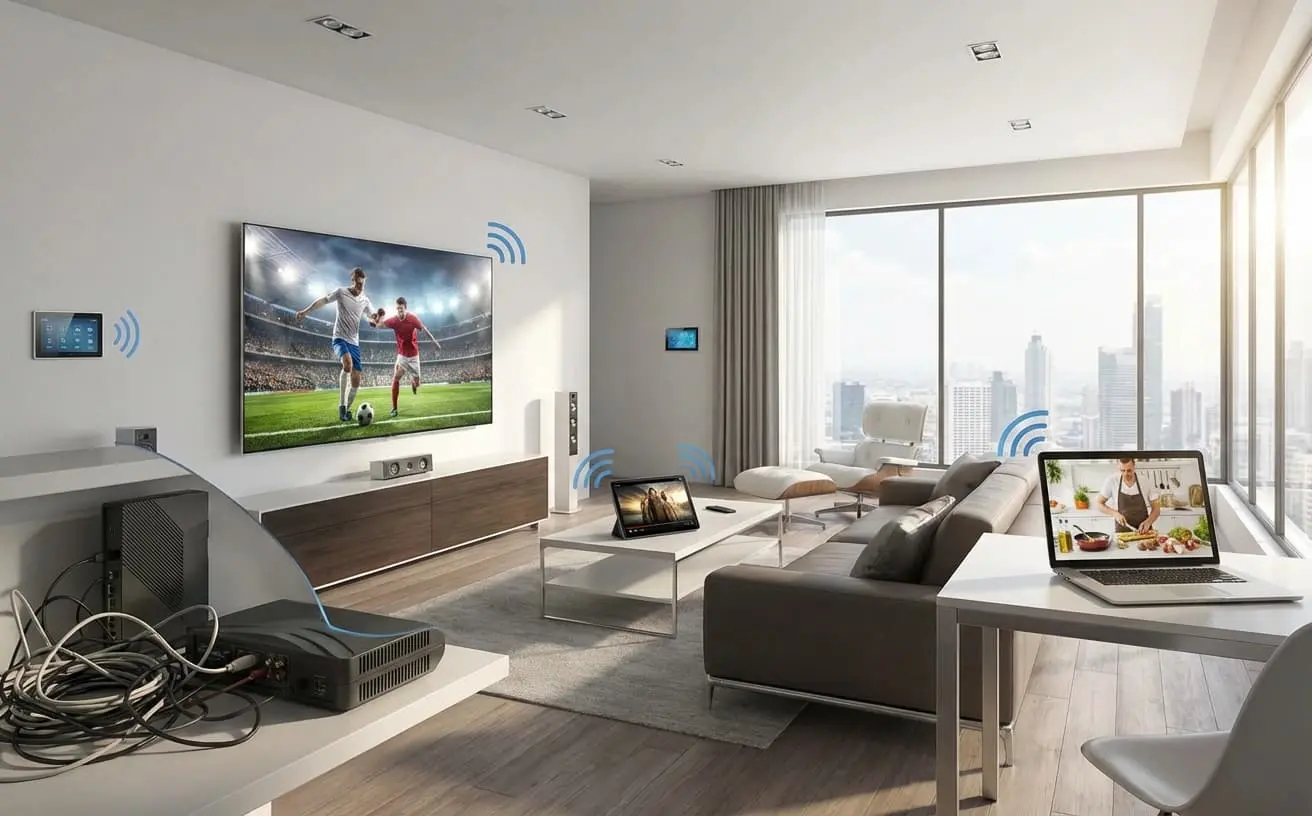
IPTV sets you free of the TV. The subscription is not a box; rather, it is an account. It means that you can enjoy an IPTV application on your smart TV, on your smartphone when you are commuting, on your tablet in your kitchen, or on your laptop at the workplace. This omniscient power is a game changer for the new generation audience.
Cons of Cable TV: Attached to a Hardcopy TV Box.
A cable plan is actually a cable that is connected to the set-top box at home.
Even though there are few providers who have developed mobile applications, they tend to be extremely limited, and when not in the home network, they are not present on channels. The box is connected to the main viewing experience that is attached to the TV.
The Cons: A Confession of the Faults of Both.
Potential IPTV Challenges
- Internet Dependency: It is everything concerning a high-speed, fast, and unlimited internet connection.
- Provider Unreliability: The market is full of unrecorded and unlawful providers, and these could either be volatile or may turn up and disappear.
- Technical Setup: Technological setup and configuration of the applications may have a little initial setup, and it may be a challenge to non-technical users.
- Unspoken Expenses: It needs to be equipped with a good router, a strong streaming box, and a strong internet package.
Downsides of Traditional Cable Television.
- Rigid Contracts: 12- or 24-month services in your contract, which is costly to cancel.
- Unfriendly Packages: They charge extra to get large packages of channels, out of which they will never view.
- Less Innovation: The interfaces and features (including DVR vs. VOD) could appear oversized and outdated compared to the new applications.
- Cover-Up Fees: The bills in most instances are overcharged with equipment rent charges, broadcast excesses, and uncharged expenses.
The Ultimate Decision: What Type of Profile of Service?

Choose IPTV If You…
- Be thankful for flexibility and diversity and hate long-term contracts.
- Require a massive amount of foreign and specialized material.
- The internet connection is stable, high speed, and unlimited.
- Technologically oriented and prefers to apply applications using the different devices.
Choose Cable TV If You…
- It shall be about stability, simplicity, and being certain.
- This is mostly through local and popular national channels.
- Slow or limited-speed internet connection.
- It functions as a classic It works just like a classic; watch it on your main TV.
The Future of Television
The trend cannot be disregarded: the internet-based future is the future of television. The current consumer demands convenience, choice, and flexibility of streaming.
To address this, the ancient cable companies are slowly evolving to offer their own streaming applications as well as more flexible offerings depending on the internet in order to compete. The difference between Internet Protocol Television and Cable Television can also remain obscure in the coming years, when the internet pipe is likely to become the primary source of all amusements in the house.